We Tested AI on Census Handwriting Across Three Decades. Here's What Actually Matters.

Michael Robellard
We Tested AI on Census Handwriting Across Three Decades. Here's What Actually Matters.
4:52
There's a lot of hype right now about AI reading historical documents, and most of it is too sweeping to actually trust. "AI reads everything perfectly" is not a claim any serious researcher should believe — so instead of making it, we tested it, found where it broke, fixed what we could, and we're telling you exactly what's true today.
The honest history
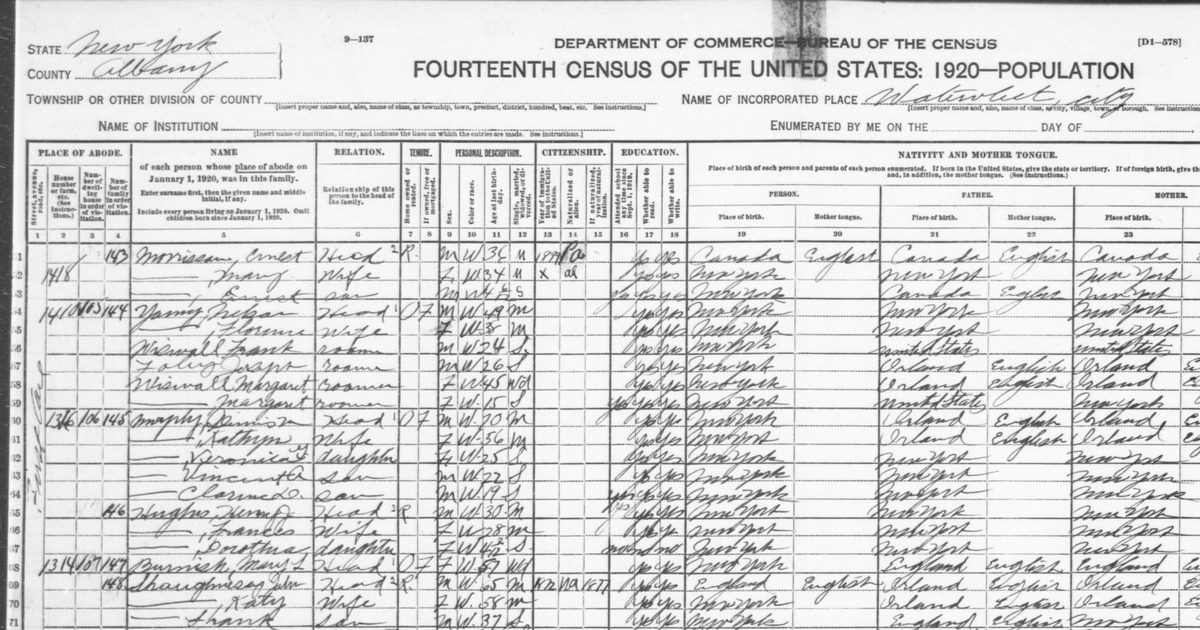
A while back, we tried Claude Sonnet 4.5 on a page from the 1920 census. It handled a handwritten family letter from the same era just fine — legible cursive, clear sentence structure, no problem. Point it at a dense census grid, though, and it produced clean, confident, plausible-looking data that was just wrong. Names shifted between rows. Ages that belonged to one person got attached to another.
The interesting part is why. It wasn't the handwriting, and it wasn't the era — the model could read 1920s cursive fine in a letter. It was the grid itself. A census page is dozens of nearly-identical rows and columns with no surrounding sentence to disambiguate anything. If a name blurs into the row below it, a letter misreads a sentence and you notice immediately from context. A misread name in a census grid just looks like the next plausible name — nothing catches it. So we shelved AI-assisted census transcription rather than ship something that looked right and quietly wasn't.
What changed
Claude Sonnet 5 and later close most of that gap. We re-tested recently against real, messy family records spanning the 1910, 1920, and 1930 census years across multiple states and counties — the kind of scans genealogists actually work with, not clean archival samples. The reads were consistently good, including full household tables transcribed as an actual readable table (not the semicolon-delimited soup you'd get from copy-pasting OCR output), correct handling of household groupings, and legible cursive on letters and draft cards from the same era.
Testing this surfaced a related, and honestly more interesting, failure mode worth knowing about regardless of what software you use: a census page almost always lists several unrelated households sharing one physical sheet — a full page might have eight or ten different families under one enumerator's handwriting. Any tool (ours included) that tries to match a newly-transcribed household against records you already have can get tripped up by that layout — a shared date and township is real evidence two records might be the same family, but on a census page, every household on the sheet shares that same date and township. It takes actual person-level evidence — a name, an age, a relationship that lines up — to tell "same family, more detail" apart from "different family, coincidentally next door." Worth checking for in anything that auto-matches records for you, not just census pages: ship manifests and city directories have the same shape of problem.
The variable that actually matters now
It's not document type, and it's not era. It's scan quality and legibility — the same thing that makes handwriting harder for a human transcriber. A crisp, well-lit scan of a well-preserved original reads reliably. A blurry microfilm scan, a heavily faded original, or a document photographed at an angle is harder to read correctly, regardless of who or what is doing the reading. That's a genuinely different, more honest caveat than "AI can't handle old handwriting" — and it means the actual predictor of a good result is the quality of your source image, which is something you have some control over (a better scan, better lighting, a flatter photo) in a way that "which decade was this written" never was.
What to actually expect
- Upload a clear scan or photo of a census page, letter, draft card, or certificate — expect a genuinely useful transcription and extraction, not a rough guess.
- A blurry or heavily degraded original will produce a rougher result. That's expected, not a bug — treat it the same way you'd treat a hard-to-read record for yourself.
- Every extraction goes through a review step before it touches your tree. Nothing gets applied automatically, and low-confidence matches are flagged rather than silently accepted. That's true regardless of how good the underlying model gets, because the point isn't to trust AI blindly — it's to save you the transcription grunt work while you stay the one making the calls. More on that specific design choice, and how it maps to the Coalition for Responsible AI in Genealogy's principles, in an upcoming post.
If you've got a document sitting in a "too hard to deal with" pile, this is a good time to actually try it — including on the free tier, no credit card required.